Skip to content
Temporary Solutions for Construction Noise
What are temporary solutions for construction noise?
Temporary solutions for construction noise are short-term, non-permanent methods used to reduce airborne noise, impact noise, and vibration caused by nearby construction activity. These solutions focus on noise attenuation, masking, and exposure reduction, not structural soundproofing. They are designed for renters, apartments, and ongoing construction phases where permanent modifications are not feasible.
When should temporary noise solutions be used?
Temporary noise solutions should be used when:
- Construction noise is time-limited
- Permanent soundproofing is not allowed or cost-effective
- Noise occurs during specific hours (daytime or nighttime)
- The goal is functional noise reduction, not full isolation
They are most effective for short-term projects, renovations, or seasonal construction.
What types of construction noise can temporary solutions reduce?
Temporary solutions primarily reduce:
- Airborne noise (machinery, drilling, hammering)
- High-frequency sounds (cutting, sawing)
- Perceived loudness (measured in decibels)
They are less effective against:
- Low-frequency vibration
- Structural-borne noise traveling through walls or floors
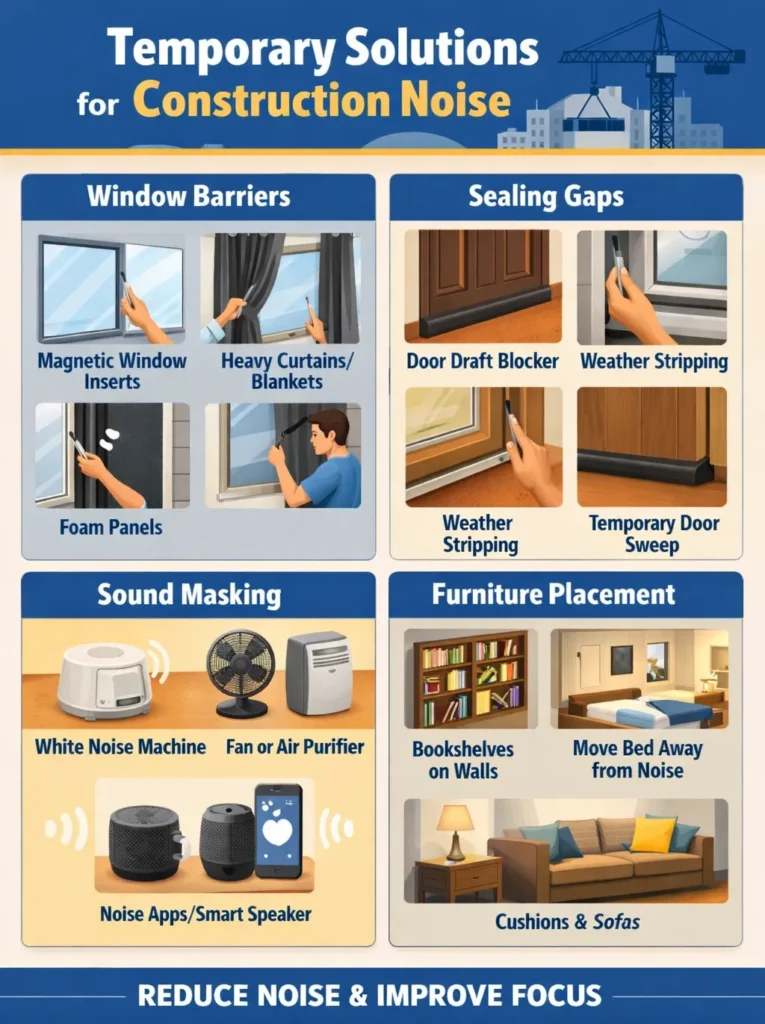
Temporary solutions that reduce airborne construction noise
Airborne noise travels through air and openings like windows and doors.
Effective temporary options include:
- Sealing gaps with removable weatherstripping
- Window inserts (acrylic or magnetic)
- Heavy moving blankets over windows
- Draft blockers for doors
- Temporary door sweeps
These methods reduce sound leakage paths, which are a primary noise entry point.
Temporary window treatments for construction noise
Windows are the largest weak point for construction noise.
Temporary window solutions include:
- Magnetic window inserts (5–10 dB reduction)
- Acrylic panels with air gaps
- Thick blackout curtains combined with blankets
- Foam board inserts cut to window size
Performance depends on air gap depth, material density, and edge sealing.
How effective are white noise and sound masking?
White noise and sound masking do not block noise, but reduce perceived disturbance.
They work by:
- Raising the ambient noise floor
- Masking intermittent construction sounds
- Reducing sleep disruption and focus loss
Common tools:
- White noise machines
- Fans
- Air purifiers
- Smart speakers with noise loops
Most effective for bedrooms and workspaces.
By reducing how noticeable construction noise feels, sound masking helps protect focus during work tasks and improves rest during sleep, even when the noise itself is not fully eliminated.
Can furniture placement reduce construction noise?
Yes, furniture can act as temporary mass and absorption.
Effective strategies:
- Place bookcases or wardrobes against shared walls
- Stack soft furnishings (mattresses, sofas)
- Create distance between noise source and listening position
This reduces reflected sound energy, not vibration.
Temporary solutions for nighttime construction noise
Nighttime noise is more disruptive due to lower background noise levels.
Best temporary methods:
- Combine window sealing + masking
- Use earplugs with consistent attenuation
- Relocate sleeping area to the quietest room
- Seal bedroom doors fully
Layering methods improves overall effectiveness.
What temporary solutions do NOT work well?
Some commonly suggested fixes have minimal impact.
Low-effect solutions include:
- Thin foam panels
- Egg cartons
- Decorative acoustic tiles
- Lightweight curtains alone
These materials lack mass and airtight sealing, which are required for noise reduction.
Effective temporary noise solutions rely on adding mass and sealing air gaps, while ineffective solutions focus only on lightweight absorption that does little to stop construction noise from entering a room.
What decibel reduction can temporary solutions achieve?
Typical reductions:
- Gap sealing: 3–5 dB
- Window inserts: 5–10 dB
- Combined methods: 8–15 dB (perceived)
Results vary based on:
- Noise frequency
- Distance from construction site
- Building structure
Temporary solutions cannot fully soundproof a room.
Are temporary solutions compliant with noise guidelines?
Temporary solutions help manage exposure but do not change legal noise limits.
For reference:
- WHO recommends ≤35 dB indoors at night
- Construction noise often exceeds 60–90 dB
Temporary methods reduce impact, not source emissions.
How to combine temporary solutions effectively
Best results come from layering strategies:
- Seal all air gaps
- Add temporary mass at windows
- Use masking for remaining noise
- Optimize room layout
This approach follows noise control hierarchy: path → perception → behavior.
Temporary vs permanent construction noise solutions
Temporary solutions:
- Reversible
- Lower cost
- Limited reduction
Permanent solutions:
- Structural modification
- Higher cost
- Significant isolation
Temporary solutions are management tools, not final fixes.
Vibration from heavy construction equipment is the hardest problem to address with temporary methods, and even well layered solutions may not fully reduce vibration related disturbance.